Now that I'm retired, I've made a pact with myself that if I see something that looks interesting that's going to happen somewhere, I'm going to explore and check it out. I don't have specific examples, but when I was working, more than once I was disappointed because there was something that looked interesting to me that I was unable to attend because I was working. I cannot even tell you when I heard about the Denver Art Museum (DAM) "Monet - The Truth of Nature" exhibit, but I knew that it looked interesting enough that I wanted to see it.
Had I been working, it would have been tough to attend, because the exhibit runs from October of this year until February of next year. With that time frame, the only way I would have been able to attend would have been during Christmas vacation and there's enough other stuff going on at that time. But, because I have extra free time now, I decided to make a road trip out of it and come in the middle of October figuring that the weather would probably be the best of the time frame. Well, that's another story altogether.
As a disclaimer, I wouldn't call myself a Monet devotee. I enjoy artwork for art's sake. I just found this exhibit interesting because it would be a very large collection of paintings by a particular artist that was supposed to show a well rounded collection of his work. I would have been just as excited about attending this exhibit had it been Picasso, or Van Gogh. I was looking forward to seeing the art, not necessarily the artist.
 The artwork was arranged over two floors of the DAM museum annex with scheduled entries every 15 minutes. When it came close to my time, I queued up and waited for them to let us in to the exhibit. As we entered, we were given headset devices that we could listen to at our leisure that gave much more in detail information about different paintings as we walked around the two floors of the gallery. The nice thing about this was it kept people fairly quiet and it was also set up on two levels, one for adults and one for kids. I listened to one of the kids level portions and that was enough for me, but I could see where it would keep younger audience members engaged in the exhibit.
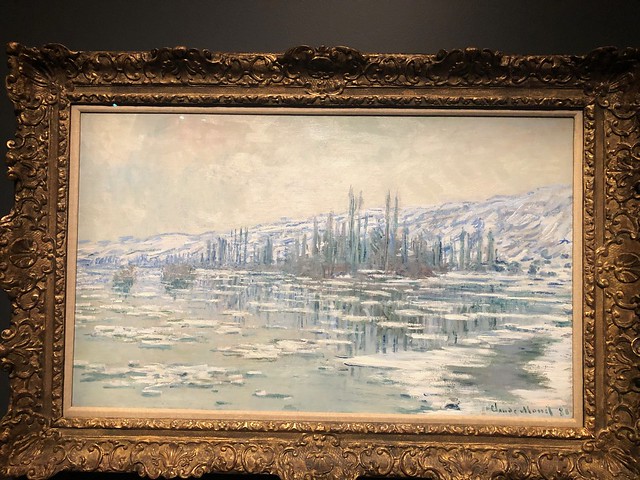
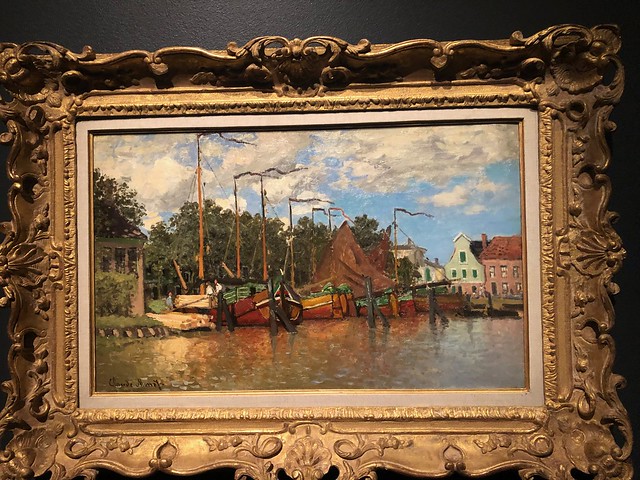
Most of the artwork was arranged chronologically, so I got to see how his art progressed throughout the years. The three paintings that I have posted here I found the most interesting mainly because of the information I had been given by my headset during the time I was looking at the particular paintings.
The first painting was taken on many of his excursions down to the southern coast of France. He loved painting the people and the beach scenes. What I found the most interesting of this particular paintings, was that they were able to discern that most of his work during this particular period, was actually painted right down at the beach and not in his art studio. He did not sketch the scene, then go back and paint the scene from memory, opting rather to paint right there. They know this because of careful analysis of the painting reveals small grains of sand in the paint that had been blown about with the breeze along the beach.
The second photo shows a waterfront scene painted in Amsterdam. Analysis of this basically proves that he painted this while sitting in a boat because it's the only spot where one could get that perspective of the scene. That's some serious dedication to sit there for hours, possibly days in a boat to get the scene the way he wanted it portrayed.
Quite possibly the most interesting painting to me was the third shot here, showing the Seine River in Paris almost frozen over during the winter of 1879. Because Monet was actively painting during this entire period, he captured the weather of the era as well. This is a time of a mini ice age in Europe and meteorologists actually use his paintings to get a sense of what the weather and climate were like in this area during this period because of his attention to details.
All in all, I enjoyed my time at the DAM and was very glad that I was able to view this collection of Monet paintings. I hope you enjoyed some of these samples of his work. If you'd like to see one other painting, there's another example of his work in this blog entry about halfway down.
Once again, it's the end of the month, which means it's time, once again for P.J.'s monthly blogging challenge. The theme for this month was liquid. I have to be honest with this one. When I first saw the theme at the beginning of the month, I figured there would be no way that I would be able to come up with anything for the theme, let alone five shots. But, once the month got underway, I saw ways that this would work, so bear with me as I think I'm stretching the boundaries a little bit with this theme, but at least I didn't have to resort to any photos of snow. Snow? Yeah, I actually saw it snow in a city for only the second time in my entire life, but that's another story that I'll tell at another time.
I'm actually doing these in chronological order, which means this first shot was taken on October 20th. Yes, I did the entire theme in less than 10 days. At first, I thought that I might get by with 5 different cave photos, because after all, what creates a cave but water? And so I figured I was done, but I'll not post a bunch of photos of the caverns, because after all was said and done, I was able to come up with 5 different liquid shots. And to also be honest here, this blog entry is sort of a teaser for other entries I'll be writing about next month.
1. Phoenix, Arizona
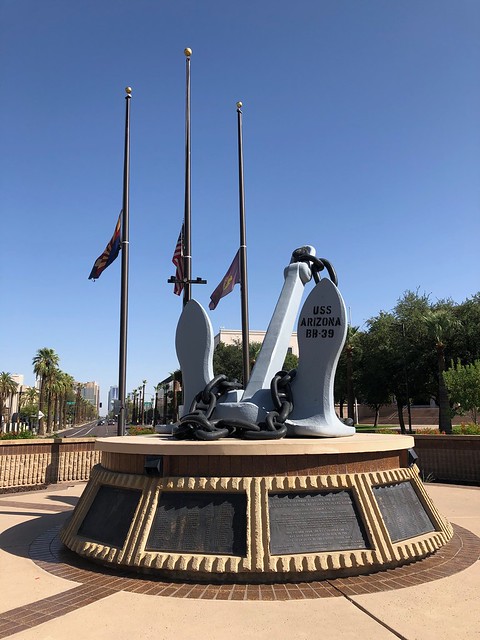
In my last post, I mentioned that I would be on an extended road trip and I just came back from that one Sunday. The main purpose of the trip was a visit to the Denver Art Museum to see a very large collection of Claude Monet paintings. The collection was only going to be there from October to February, so I figured this would be the best time to go to avoid really bad weather. Anyway, the first day of the trip took me through Phoenix. And, as usual, I spent some of the time on the drive geocaching. I ended up in downtown Phoenix, where there is a large war memorial to all of the different wars our country has been involved in. Part of this park is where I discovered the USS Arizona's anchor. Pulled from the liquid depths of Pearl Harbor in Hawaii, this anchor is on permanent display at this park in Phoenix. Around the base of the anchor are all of the names of the brave men who perished on that fateful day in 1941.
2. Guadalupe Mountains National Park
This was a new place I'd never visited before and originally, I had planned on camping here, but things fell through on the opposite end of the trip, so I ended up staying at motels along the way. This was actually a good thing because camping was very limited in this park. The Guadalupes are the extension of Carlsbad Caverns, only above ground. I spent most of the morning exploring the Caverns, and after having thoroughly explored them, I ventured south to this national park, just across the border in Texas. This park is mostly wilderness, which means little to no roads and mostly backcountry camping and hiking, something I wasn't equipped for on this trip, but I was able to get a feel for this area nonetheless.
West Texas is pretty much desert and the Guadalupe Mountains rise like an island out of this desert, providing refuge for an abundance of wildlife and plant life. I took this photo of this prickly pear cactus mainly because I liked the contrast of the brown and greens with the light violet of the flowers on the left. And if you're ever stuck out in the desert without water, you can, in a pinch, open up the cactus and get some liquid refreshment which will sustain you for a little bit.
3. Monet
The reason this trip happened in the first place was because of this collection of paintings. I can't remember where I first heard about this exhibition, but as soon as I knew about it, I started making plans to see it. The exhibition was falling at a perfect time: the fall and winter following my retirement. Since this exhibition was only happening during this time period, I probably wouldn't have been able to see it since I was working during most of that time. That's one of the benefits of retirement. I highly recommend it.
The main building of the Denver Art Museum is undergoing extensive renovation and the museum is in the annex building across the street. This means the collection of artwork on display is small at this time, but they had some interesting works dealing with the study of light.
The bottom two floors of the annex were dedicated to Claude Monet and his life. Each of the patrons were given audio guides to learn more about the paintings and about different periods of his life. The galleries were arranged in approximately a chronological order. Since he created most of his lily pad and pond paintings near the end of his life, this was the last room of the gallery that I walked through. The way the liquid paint created the illusion of the liquid water in the lily pond is just amazing, in my opinion.
4. Chocolate Porter
Coming home later in the week, I ended up in Albuquerque, New Mexico. One of the nice things about traveling is checking out the local cuisine. There were times on this trip where I'd eat at a place that I was familiar with because I just wanted a quick meal and there were times when I wanted something a little bit more tasty and different. That night in Albuquerque was one such nice, so I decided to try a local barbecue place. It was recommended to me by the waitress that I try the burnt ends sandwich, a decision which I will not regret. I also have an affinity for dark, very dark beers, the kind you can almost chew. This chocolate porter certainly filled that bill and went quite well with the barbecue sandwich I had. The Nexus Silver Taproom will be someplace I will probably visit again should my travels take me through northern New Mexico.
5. Continental Divide
Finally, on my next to last day of my trip, I traveled from Albuquerque to Flagstaff, Arizona where I would spend my last night. Heading toward Denver, I missed when I exactly crossed over the continental divide, but this spot along Interstate 40 is very hard to miss. With signs on either side of the freeway, it's pretty much a spot where travelers stop and get their photos taken.
It's also the spot, where liquid falling to earth gets separated. Rain and snow falling on the eastern side of the continental divide will eventually make it to the Gulf of Mexico. In this case, the water would flow into the Rio Grande, which forms the southern border of Texas with Mexico. Rain falling on the western side would eventually flow into the Gulf of California and into the Pacific Ocean. Most of the rain that fell here would flow eventually into the Colorado River and through the Grand Canyon.
It's always intrigued me how cartographers were able to graphically map this out and figure out where each little stream would eventually drain. If you've ever looked at a map of the continental divide, you'll see some very interesting details. In southern Wyoming, it actually splits in two, creating a basin where the water doesn't flow to either, but either evaporates or flows downhill to the lowest point in that basin where it percolates back down into the groundwater. Further north, in Yellowstone National Park, there's a lake that literally sits right on top of the continental divide. The lake has two outlets, one flowing to the Atlantic Ocean and the other flowing to the Pacific Ocean.
For hiking enthusiasts, there's also the Continental Divide Trail, a national trail which loosely follows the Continental Divide from the southern border of New Mexico all the way to the northern border of Montana. Somewhere in this area, I also crossed over that trail.
And there's my interpretation of the theme liquid. Some might call this a stretch, but it worked for me. Please check out P.J.'s blog and scroll down to the bottom. You'll see other blogs and their interpretations of the same theme. And as always, feel free to comment. I won't bite.