Showing posts with label Yellowstone National Park. Show all posts

Thursday, March 2, 2023

Collections and traditions

For those of you who know me well, you already know that I'm most comfortable in tee-shirts and shorts, unless it's the winter months and then it's tee-shirts and pants. Not really much difference, but at least it keeps my legs warm.

Anyway, most, if not all of my tee-shirts are ones that I've purchased when I travel. I started this way back in high school when the family would camp in Yosemite National Park almost every summer. And every time I was there, I would purchase a Go Climb a Rock tee-shirt. It sort of became a thing for a while there and I had a Go Climb a Street shirt that I bought in San Francisco and a Go Climb a Volcano shirt that I purchased in Lassen Volcanic National Park. I even had a gag tee-shirt that a friend of mine purchased for me that said Go Climb Mt. Fuji.  

After high school, I tended to drift away from the Climb shirts and just purchased ones that I liked. Most of these tee-shirts center around the national park experiences, but there's also novelty tee-shirts that some of my family and friends have purchased for me. So what does this have to do with anything?

Well, when I'm out and about I tend to wear a tee-shirt that fits the theme of the day.  If I'm geocaching, then of course, the likelihood is I'll be wearing a geocaching tee-shirt.  If I'm camping, more than likely, I'll be wearing a national park shirt. Family visits usually mean I'm wearing a shirt given to me by one of my kids.  You get the idea now.

After looking over some of my more recents shots I took at several national parks, it seems like I have a "Go to" shirt for when I enter a national park and get my photo taken at the entrance sign of said national park. I'm wondering if it's my subconscious telling me that I have to wear my Yellowstone National Park tee-shirt every time I enter a national park, or if it's just a coincidence? It's probably the latter, but no matter what, since this has become sort of a tradition, I obviously will be wearing that tee-shirt on my next excursion out into a national park, or at least when I get my photo taken at the entry point sign. And of course, because I noticed this, I'm going to either have to get back to Yellowstone to get a couple more tee-shirts, or order some on-line so I have a ready supply for future trips.

Sunday, May 10, 2020

Wind Cave

Looking back on this blog, I realize that I haven't covered all the spots my youngest and I visited on our cross country road trip to Wisconsin the summer of 2017. With extra time on my hands at this point in time, I might as well get back to that trip and let you know about spots we visited on the way to Wisconsin as well as spots visited on the return trip. When I last wrote about this trip, it was July last year and I wrote about Mt. Rushmore. Right after that I ended up taking an extended camping trip to Utah, Idaho and Nevada, so I got caught up in that trip. Since I've covered that trip pretty extensively on this blog, it's time to revisit the 2017 trip.

Following our quick two hour visit to Mt. Rushmore, we headed south into Custer State Park and then into Wind Cave National Park. The two parks boast broad sweeping vistas, bison herds, but Wind Cave also has an underground cavern that's open for tours. We ended up driving through the state park in order to get to the national park. If you look at the first photo, you'll see there's a fence at the border between the two parks. Most animals can either burrow under the fence or hop over the fence so animal movement is not really impaired with the exception of the bison herds. There's a reason for this fence and that's to keep the two herds in the parks separate.

The bison herd in Wind Cave is a genetically pure strain of bison. Most bison in the United States, are genetically mixed with cattle. The herd in Yellowstone National Park and the one in Wind Cave are genetically pure, so it's advantageous to keep the strain a pure strain for the future of the overall species. This is why there's a fence around the entire Wind Cave park. The bison herds in Custer State Park, are not genetically pure and the National Park Service wants to keep the two herds separate for reasons explained above. The entire herd in Wind Cave are direct descendants from Yellowstone bison that had been captured in 1800s and then bred in the Brooklyn Zoo in New York. The herds in this area had been pretty much wiped out during the late 1800s, and when the park was created, offspring from the Brooklyn Zoo bison were reintroduced into Wind Cave National Park. Every year after calving, the herd is rounded up and culled, with some of the offspring sent to other areas in order to keep a genetically diverse line of bison. The photo of the bison was actually taken in Custer State Park as we didn't see any of the Wind Cave herd while we were there, so I'm actually glad that we ended up taking the scenic route through Custer.

Once inside the national park, we headed to the visitors center and purchased tickets to take one of the tours that were offered that afternoon. The cave is composed of over 100 miles of passageways, 3000 different chambers, the largest of which is larger than the largest room in Mammoth Cave National Park in Kentucky. Cave popcorn, frostwork and box-work are the main types of formations in this cave, giving it a much different feel than many of the more traditional caverns like Mammoth Cave and Carlsbad Caverns. There aren't nearly as many imposing structures like you would see in other caves, but each cave is unique in its own right and it's one of the reasons I enjoy exploring caves - the differences that make each one unique.

I had been here once when I was a teenager and the main thing I remember of this cave was the Post Office, a formation of calcite that created something that looked literally like a set of post office boxes. You can see something similar to that in the last photo.

Following our tour of the cave, we came back out and encountered a gathering thunderstorm, which meant that our planned hike above ground would have to be curtailed and we decided to get back in the Jeep and head back to Rapid City where we would be spending the night. Nothing like driving through a torrential rain storm with thunder and lightning all around and hail falling down. Fortunately, it wasn't a really violent storm, so the hail stones were small and didn't dent the car.

In the coming weeks, I intend to continue with this series, taking you to Badlands National Park, the Gateway arch in St. Louis, the Buddy Holly memorial in Iowa, and three different presidential libraries. Thanks for stopping by.

Friday, October 11, 2019

Craters of the Moon

There are a variety of things that I enjoy about road trips. Visiting places again to rekindle the enjoyment that I had the first time around is one of them, but I think visiting new areas and exploring things I haven't seen before is even more exciting. That's one of the reasons why I decided to visit Craters of the Moon National Monument on my first road trip this summer.

The park, which is located in Idaho, has been on my radar (bucket list) for quite some time. My time in Idaho, previously, had been limited and I'd never gotten this close to the monument before, although I suppose you could argue that my youngest and I could have stopped there while heading up to Yellowstone National Park, but I guess the lure of the geysers was stronger than the lure of the lava fields. This trip, Craters of the Moon was going to be one of the central pieces of the trip, one where I'd spend a longer period of time to really explore the park.

I got there early in the afternoon, since I only had to drive from Pocatello, Idaho. While on the drive, I stopped here and there to find some geocaches, but I wanted to get to the park early in order to secure a good camping spot. First come, first serve sites area always unpredictable. Many times previously, when I'd visited Cedar Breaks National Monument, I had my pick of the campground, but this trip when I stopped there, the campground was almost full. Needless to say, I wanted to make sure I had a campsite.


The campground is one of the coolest campgrounds I've ever encountered in a national park or monument. I believe the park service just literally bulldozed spots out in the middle of this huge lava field. Many were very secluded, with high rock walls all around, which was very important, as those rock walls cut the wind that whipped through the campground and park during the day.

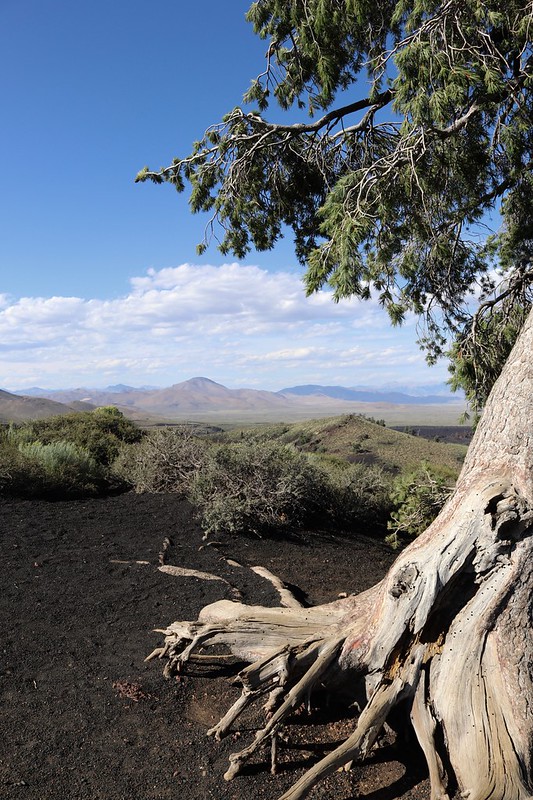
I got a pretty nice campground and then went around and explored what I could that afternoon. I drove outside of the visitors center area over to an overlook that gave me an incredible view of the lava fields that formed the park. From this vantage point, it was very easy to see the different fields and to tell which were older, based upon the size and amount of the vegetation. The older fields had Limber Pines growing, while younger fields had small sage and plants, or perhaps very little at all.

I then came back into the main area of the park and drove the loop drive, stopping at pullouts here and there to work on several earth and virtual caches that were present in the park. The virtual cache took up the most time because it wanted me to get information from different points around the park, so I decided to concentrate on that. Even so, as I worked on one part of that cache, I ended completing another earth cache which was located at the top of a huge cinder cone in the middle of this particular area. 

The views from the top of that cinder cone were amazing as you can see from the second photo. I actually went back and forth with myself whether I wanted that second photo to be in color or black & white, but as you can see the color side won out. Whenever I take landscape shots, I always look at them as to whether they'll look good in black & white, mainly because I'm a big fan of Ansel Adams' photography.

Finally, after a good afternoon of exploring, I went back to camp, ate dinner and walked around the campground marveling at all the stars I could see in the night sky. Many of the parks in this area of the country have been designated "Dark Skies" parks, because of their remoteness to city lights. Few of us ever see many of the stars in the night sky anymore due to light pollution, so it's always nice to get out in an area where you can see the Milky Way galaxy at night. Unfortunately, I couldn't see the Milky Way for very long, since I happened to be there during the full moon cycle for the month and the moon, once it rose, pretty much washed out much of the sky.


The next day was spent exploring the far reaches of the loop drive and areas I hadn't been able to get to the previous day. I went on several hikes, including the tree molds trail, where I got some nice landscape shots and was able to see some tree molds created by the lava flowing around trees and preserving their outlines. I also got to see where the lava fields stopped flowing near some splatter cones. One splatter cone was called Snow Cone, because it had a large snow dome down inside of it.

That evening, I was treated to a spectacular sunset. After dinner, I decided to head out to one of the parking lots on the loop drive so I would have a large expanse of area in which to move around and take some photos. The evening sky did not disappoint. I have several others, but I think this one, is by far and away the best of the bunch that I took that evening.

Craters of the Moon is one of those parks that if you're going to see it, you really want to go see it, mainly because it's far off the beaten path. It's uncrowded and if you get there early on a trail, or stay late, you pretty much have the place to yourself. I got on the Tree Molds Trail around 8 in the morning, hiked the two miles or so all the way out to the end of the trail and encountered one other person the entire time I was on the trail. Another trail that I walked after dinner and before sunset had no one on it and it was like I had the entire park to myself. It made it very easy to get lost in the beauty of the earth and forget about the crowds. This is someplace I'd visit again.

Sunday, July 21, 2019

Yellowstone

This is the 3rd of a series of semi-regular articles chronicling the 2017 road trip my youngest and I took to Wisconsin and back again.  This is something that, after you read this, think to yourself, "don't do Yellowstone in just one day."

The first time I visited Yellowstone National Park, I think I was 12 or 13 and we spent at least a week there.  The second time, I was newly married and my wife and I spent 3 days.  This time around, my youngest and I spent just a day in the park, driving in from Idaho, then driving back out later that evening at dusk.  There is no way, that's nearly enough time for anything, but we packed as much as we could into the day, hiking, sightseeing and geocaching.

We came in through the West Yellowstone entrance and then headed toward the geyser basins.  The first major stop was at the Grand Prismatic Spring seen in the first shot.  This alone is worth a partial day visit.  I wish there was a way I could convey the colors, the smells and everything about this, but I just can't.  This photo is close, but I don't think it does it justice.  And we didn't even get around to the other side.  There's a trail on the hillside that gets you at elevation above the spring so you can see how truly grand it is and how large it is.  That, in and of itself, gives me another reason to go back and spend more time there. It's the largest hot spring in the United States and third largest in the world.  It measures 370 feet in diameter and is 160 feet deep.


After the spring, it was on to the Old Faithful area.  All I can say is check the geyser schedule somewhere ahead of time. We got there at noon, about 10 minutes before eruption and it took us 15 minutes to find a parking spot.  Because we were day tripping in the park, we didn't really have a choice as to when we were going to be there.  Needless to say, we didn't see it erupt that time, but watched it erupt twice more that afternoon, once by the seating areas and once from a trail.  The second time, it was erupting while Beehive geyser was also erupting.  That's pretty spectacular to see two different geysers fairly close to each other erupting at the same time.

The rest of the afternoon, we spent hiking here and there among the geysers, taking in the sights, doing virtual and earth caches.  Earth caches and virtual caches are geocaches that don't have a physical container.  Virtual caches usually take you to a specific place of scenic or cultural beauty and you have to answer a specific question about the spot, or post a photo of you at the spot to prove that you were there.  Earth caches are similar, only the spot is geological in nature and you have to answer geology questions based upon what you see at the spot.  The National Park Service, with a couple of exceptions, doesn't allow physical geocaches in the parks because they view them as litter.  They do allow virtual and earth caches though, so we spent the day doing those.  With all of the stuff we were learning, our brains literally hurt by the end of the day.


While we were there, we watched Old Faithful erupt at around 2:30 or so.  Packed house.  We hiked around some more in the area, then went to nearby restaurant to eat dinner.  Came back out and watched Old Faithful erupt again and could have had our pick of seats in the seating area at that time.  Lesson learned.  If you have time, wait until after dinner to watch Old Faithful erupt.  Most of the crowds have dispersed back to their hotels or campsites and the parking lot has many spaces available.  I don't think it's ever not crowded there, but there were definitely less people later in the evening.  In the summertime, it doesn't really get dark until after nine o'clock, so you have lots of daylight hours in which to work.

After dinner, we drove over the continental divide and drove down to view Yellowstone Lake.  There was another geyser basin right along the lakeshore, so we walked the boardwalks there and enjoyed the peacefulness of the lake.  There were not as many people here, mainly because it was getting later on in the day and as noted above, most people had "gone home" for the day.  After sightseeing lakeside, we hopped back in the Jeep and made our way back through West Yellowstone and into Idaho where we were staying the night. A bison jam slowed us down, but that was pretty cool watching a herd of bison walk across the road in front of us.  At least we weren't going the other way on the road where a bison decided to lay down in the middle of the lane and take a siesta.

Moral of the story is, don't even think about just spending a day there.  I think you need a week, maybe longer to fully enjoy the park.  I know I'm going to be spending some more time there in the future.

Tuesday, July 2, 2019

Manzanar

One of the things I've always written about in all of my blogs are trips that I take that I find significant.  Back in 2017, I went on a 16 state road trip with my youngest and yet, for some strange reason, never chronicled that trip in any way, shape or form, outside of some photos that I posted to Facebook. I will attempt to rectify that over the course of the next couple of months as I share some of the photography from that trip and some of the places we visited along the way.

Originally, the two of us had thought about taking a trip to Yellowstone National Park that particular summer.  We had discussed it casually in the fall of the year before but hadn't really solidified anything, so it sort of stayed on the back burner.  Then in February of 2017, my father-in-law passed away and the family had to sort out his house and deal with the things that you have to deal with when a grandparent/parent dies.  There were several pieces of artwork that my wife's sister particularly wanted. The question was how to get it back to her in Wisconsin.  That's where the idea of this 16 day road trip was spawned.

We started planning our route out and once the planning had been done, I then started looking for places we could camp each night.  It was then my son pointed out the errors of my thought process by pointing out, that with all of the extra stuff we were taking back to Wisconsin with us, we wouldn't have any room in the Jeep for camping equipment.  Yeah, I'd sort of forgotten that the Jeep is a little bit smaller than our former minivan that we'd used on previous camping trips.

So we ended up staying most of the time in motels along the way. As with all of our road trips, geocaching is involved and so there were several goals attached to that end of the trip as well.  Getting different kinds of geocaches in each state we passed through, finding a geocache in every county we passed through in Nevada.  If we played our cards right, we'd have the entire state covered at the end.

So the trip started and we drove north on Hwy 395 through the Owens Valley up the eastern side of the Sierra Nevada, stopping for lunch, stopping for gas and stopping once again at Manzanar National Historic Site. I say, once again, because every time I head north along Hwy 395, I stop there.  The historical importance of this "Relocation Center" cannot be stressed enough.  Over 110,000 Japanese Americans were relocated to 10 different camps in the Western United States during World War II, ostensibly because of their race and who we were fighting in the war.  The premise that was given by our own government was that it was for the protection of the people in the camps.  If that was the case, why were the guns pointed inward at the camps?  I'll let that sink in a little.

The first time I visited, I was 19 years old and had no idea what Manzanar was all about.  I made sure each of my children visited the place at least once.  This should never happen again in our country.  Ever.