I've been ruminating this post in my head for months and finally decided that I needed to write it out and today, President's Day, felt like the perfect day to get this one out to the public. As an aside, I have three calendars on my wall over my computer monitor and all three of them have a different way of noting today. The Yosemite Conservancy calendar lists it as President's Day. The Nature Conservancy calendar lists it as Presidents Day. The National Park Foundation calendar lists it as Presidents' Day, so I guess, the choice is yours as to which you prefer.
In my wanderings, I've been able to visit 5 Presidential libraries. Obviously, the California libraries (Nixon and Reagan), I've been to more than once, while the other three, I've only the opportunity to see once, however, I've been to the Lincoln Home National Historical Site more than once. Please understand these ratings are totally subjective and my opinion alone. Your mileage may vary depending upon your own preconceived notions about each man as well as your own perceptions after visiting each library. If I visit other Presidential libraries in the future, I will update these ratings including if I revisit any of the ones that are listed here. I will however note, that when I asked my youngest which ones they favored, they came up with the exact same ratings as I did, so either I've influenced them greatly, or great minds think alike. More than likely, it's a combination of the two. Also, I've chosen to write about each library in order of preference, from my least liked to what I felt was the best of the five. I will put links to all of the libraries and the associated historical sites in each rating as I get to them.

#5
Richard Nixon Presidential Library and Museum
18001 Yorba Linda Blvd.
Yorba Linda, CA 92886
The library, which is the closest to where I live and also the one that I've visited the most has a very good depiction of the 37th President's life with plenty of artifacts of the president as well as several interactive exhibits. There is a small piece of the Berlin Wall on display and the last time we visited, there was a huge flag created out of nothing but LEGO Blocks. For my 12 year old at the time, this was very cool.
One of the neatest exhibits I enjoyed was the World Leaders area where the museum had life sized representations of all of the world leaders of the time that you could walk amongst to get a perspective as to how tall or short some were. Preconceived notions about some world leaders definitely came into play in this exhibit and I was incredibly surprised to see how short Nikita Khrushchev was. When you read about powerful world leaders, you sort of expect them to be larger than life and yet, Khrushchev was only about 5' 3". Seen in the photo above is my youngest standing between Winston Churchill and Charles DeGaulle. My youngest stands about as tall as DeGaulle now.
Other highlights include Marine One, the helicopter that flew Nixon and his wife away from the White House on the day he resigned, which you can walk through. The house where he was born is also on the property and you can also tour this. Nixon and his wife are also buried on the grounds, so you can also pay your respects to the former president and First Lady.
The reason this one falls short, in my opinion is it was originally created by a group of "Friends of Nixon." Apologies in advance for not knowing the exact organization, but you'll understand as you'll see a pattern in my ratings. This group wanted to keep Nixon's legacy strong and positive, so in the beginning, there literally was no mention of the events surrounding the Watergate Hotel. It was as if it had never happened. Eventually, the National Archives has taken over the running of the museum and the last time I was there, they were working on an exhibit explaining Watergate and what happened. This, I felt was the major downfall of the museum and I think it would be higher on my list if there was a more balanced presentation of Nixon's life and career.
Dwight D. Eisenhower Presidential Library, Museum & Boyhood Home
200 SE 4th Street
Abilene, KS 67410
As noted in the title, not only can you visit the museum, but you can also tour the boyhood home of the 34th president. You can also pay your respects at the gravesite of the former president and First Lady which are located on the grounds.
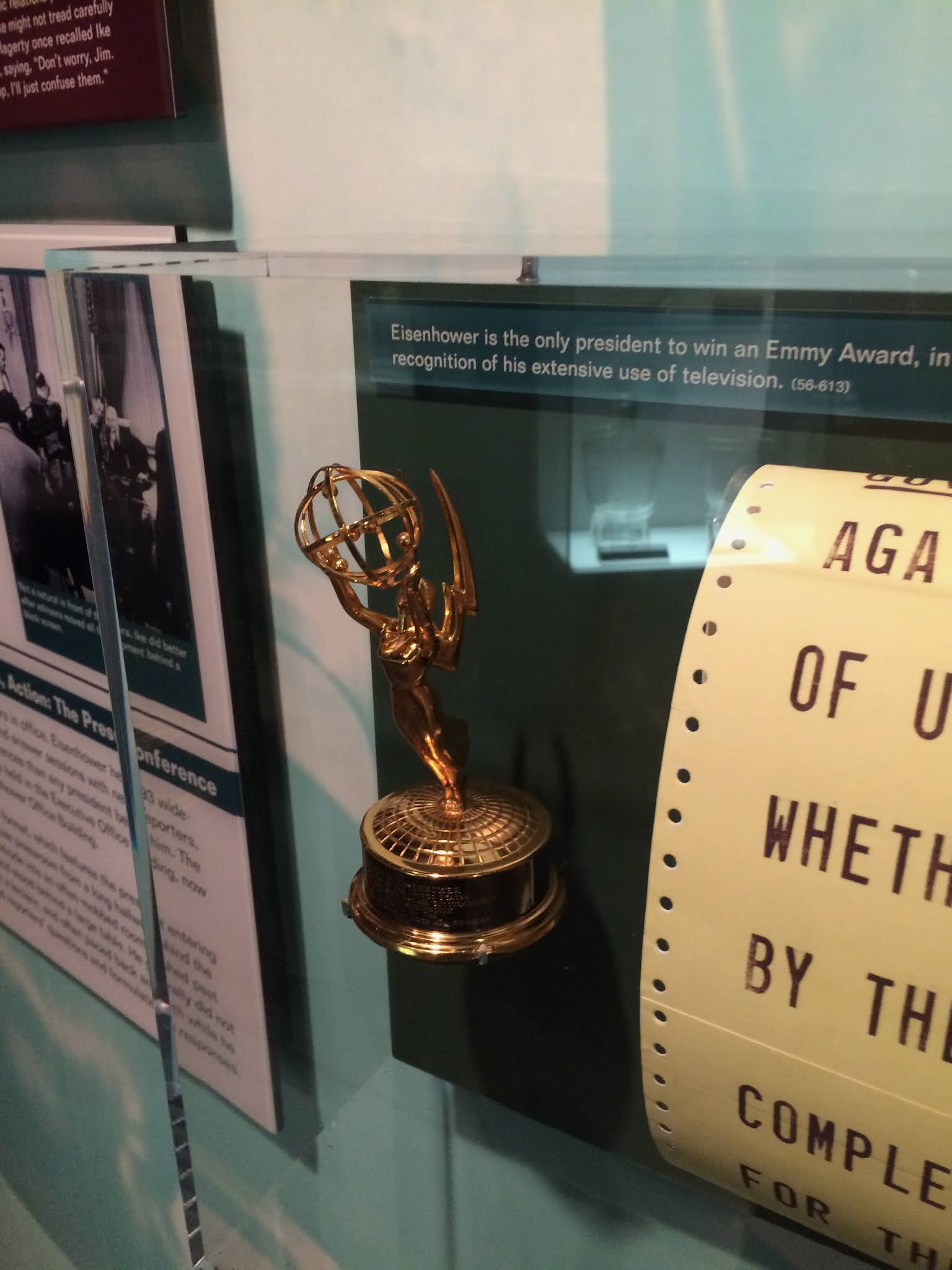
The museum has a well rounded amount of artifacts surrounding Eisenhower, throughout his military career and including his presidency and post presidential career. Clothing the president wore are on display as well as military vehicles the president used before retiring from the service. Known to be an avid golfer, there is even a scorecard for a round of golf the president had with Ben Hogan. Obviously Hogan won the round, but looking at the card, you can see that with handicaps figured into the scores, the President actually won the round that particular day. I found the Emmy, the only one won by a President to be very interesting, especially with Ronald Reagan's use of television in the subsequent years.
As I noted in this blog post however, there were a couple of things that I felt downgraded the museum making it fall to fourth on my list. There was very little mention of his wife Mamie. Yes, there were some artifacts, but it was almost as if she was an afterthought in this life, as opposed to his life partner. The second thing I found wanting was similar to Nixon's library, in that this library was originally established by "Friends of Eisenhower" and later taken over by the National Archives. Although the museum has a fair representation of Eisenhower's life, it still didn't seem very balanced, as if Eisenhower never did anything wrong in his life. This doesn't seem, in my mind, like a good telling of history at all if all you're going to do with a certain exhibit is tell about all of the good things and not balance them out with their mistakes. Imagine if a biographer did that about John F. Kennedy and never wrote about the Bay of Pigs? That wouldn't be a fair representation of the man or the time period. That's what I found to be the case at Eisenhower's museum.

Abraham Lincoln Presidential Library and Museum
212 N. Sixth St.
Springfield, IL 62701
Lincoln Home National Historic Site (NHS)
413 S. 8th Street
Springfield, IL 62701
I've included both the Museum and the Lincoln Home in this review mainly because they are tied together. The first time I visited Springfield as a teenager, the museum didn't exist. My family toured the Lincoln Home, the only home the 16th president owned, as well as his gravesite in the main cemetery in Springfield. The museum is new addition to the arena of presidential libraries, as they are basically a 20th century phenomena starting with Herbert Hoover. I may be wrong, but no other president before Hoover, with the obvious exception of Lincoln has their own library.
The best word I can use to describe the Lincoln Museum is "Slick." Since it's a new museum, it uses the newest technology available to get the story of Lincoln out to you. There's one presentation in a theater where you're told the story of the Civil War through a skit that was amazing in scope. It took me until the very end of the presentation to realize that what we'd been watching, was not a flesh and blood actor acting out the lines that he'd rehearsed, but a holographic image. Very impressive and like I said previously, slick.
Because this library is run by the state of Illinois, Abraham Lincoln can do no wrong here. The great emancipator is portrayed as larger than life. There is a more balanced approach to the man at the Lincoln Home NHS, mainly because it's run by the National Park Service (NPS). One of the interesting tidbits I picked up at the Lincoln Home surrounds the tree out in front of the house. This tree is replaced every so often as they are trying to keep the house looking like it did in 1860 just before Lincoln left for Washington. Obviously, he never returned to life in the house afterwards, but because the NPS keeps replacing the tree, you still have a good view of the house, without it being obscured by a larger tree if they'd allowed the same tree to grow.
What the museum also lacked was any large scale collection of artifacts of the former president. I blame that on historical timeline. The fact that this museum showed up late in the game nearly 150 years after Lincoln's death is probably a prime factor in the lack of personal artifacts of Lincoln or his family. Most of the heirlooms can be found in the nearby Lincoln Home NHS, which I've listed above. That being said, I think the presentations more than make up for the lack of artifacts which is why it's here solidly in the middle of my rankings.

Ronald Reagan Presidential Foundation and Institute
40 Presidential Drive
Simi Valley, CA 93065
The library dedicated to our 40th president is located about an hour and a half west of where I presently live, yet I've only visited once, although I know I'll visit again once the pandemic is under control. The museum does a good job telling the story of Reagan, although, once again, because it's not run by the National Archives, it's not necessarily balance in approach, but the overall exhibits more than make up for this shortfall in my estimation.
There's a good collection of memorabilia associated with all aspects of the man's career, both before, during and after his presidency. There's an entire piece of the Berlin Wall on display outside in a courtyard. Obviously, it's fenced off to prevent idiots from walking off with small pieces of it, but it's impressive even from a short distance. Reagan and the First Lady Nancy are both buried here, although I haven't seen Nancy's grave as she was still alive when I last visited the museum.
When we visited, there was a temporary museum piece displaying an original Magna Carta document, one of three or four known versions of the original document. The nice thing is we were able to view it very close hand under glass and as I was viewing it, I realized that I was looking at one of the most important documents in the world and it had creases and folds in it. Obviously, the people of the time, when they transported it around probably folded it up and put it inside a pocket for safe keeping. Can you imagine if someone did that today, with say, the original Declaration of Independence? Yeah, it wouldn't happen, but it was interesting to note it.
By far and away, the coolest permanent exhibit at the Reagan Library is Air Force One. It's located in its own building, put up on pedestals and you get to enter the plane from the front fuselage and then walk through the entire plane seeing what it looked like at the time and then exit out from the rear of the plane. You can also see another Marine One, similar to the helicopter at Nixon's library there. I would also like to add at this time, that in all but Lincoln's Library, there was a recreation of the Oval Office in the White House as it looked during that particular president's tenure in office. It was very interesting to see the different styles of each president and the artwork, paintings and rugs they chose to adorn their working office.

Harry S. Truman Presidential Library and Museum
500 W US Hwy 24
Independence, MO 64050
Harry S Truman National Historic Site (NHS)
223 North Main Street
Independence, MO 64050
Once again, I've included both the museum and the NHS in this rating, mainly because they're so close to each other.
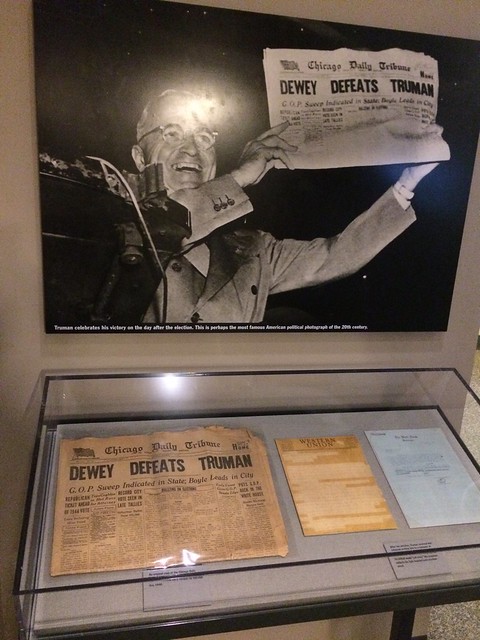
As with other presidential libraries, this one had a great collection of memorabilia from the 33rd president's life, before, during and after. Included in the artifacts were several of the cars Truman owned in his lifetime. The delegate badges both he and his wife wore during the 1944 Democratic Convention were also on display. There were several interactive exhibits inviting the visitor to express their opinion about the man who became president during one of the scariest times in American History, the end of World War II and the beginning of the Cold War.
The museum did not shy away from controversial topics either, having an interactive piece on the dropping of the Atomic Bombs on Hiroshima and Nagasaki. Visitors were encouraged to express their opinions about the dropping of the bomb and how to access the man who made the ultimate decision. As noted above, there was a recreation of his Oval Office. I have to say, I think Truman's favorite color was green. Located on the grounds is his gravesite where he and his wife, as well as his daughter and son-in-law are buried, so visitors can pay their respects.
About 5 blocks away is the house Truman lived in for most of his adult life and tours were offered there, which we took full advantage of to learn a little bit more about him. Even without the tour of his house, which was not part of the museum, but part of the NHS, Truman's museum was by far and away, the most balanced in its portrayal of the President. There were lots of artifacts and the museum didn't avoid some of those controversial decisions he made while president much like the other museums did. As we were leaving, near Truman's gravesite, this quote stood out as a testament to him, "The Truth is all I want for History."
And there you have it, my most likely biased opinions on the five presidential libraries I've visited. Once everything settles down again and I'm able to travel more freely, I'll be looking for other presidential libraries to visit. I believe the closest one to me that I haven't visited is in Texas. I look forward to any comments you have.